The Invention of the Century: Privacy
November 13, 2010
Privacy is considered to be an important issue for it is not just a social structure within a community, which can be regulated by social control anymore. It has developed to a dialectic notion of widespread surveillance activities within modern society. The notion of privacy that seems so important to us is a concept invented in the 19yh century, within the change of our modern society, nowadays our notion of privacy as cultural structure changes as well.
I have nothing to hide
In “I’ve Got Nothing to Hide and Other Misunderstandings of Privacy” Associate Professor at George Washington University Law School, Daniel J. Solove explores the privacy discourse by stating that; “The argument that no privacy problem exists if a person has nothing to hide is frequently made in connection with many privacy issues. When the government engages in surveillance, many people believe that there is no threat to privacy unless the government uncovers unlawful activity, in which case a person has no legitimate justification to claim that it remain private.” As he explores; “the ‘nothing to hide’ argument and its variants in more depth. Grappling with the ‘nothing to hide’ argument is important, as the argument reflects the sentiments of a wide percentage of the population. In popular discourse, the ‘nothing to hide’ argument’s superficial incantations can readily be refuted. But when the argument is made in its strongest form, it is far more formidable.” He claims that; “The problem, in short, is not with finding an answer to the question: ‘If you’ve got nothing to hide, then what do you have to fear?’ The problem is in the very question itself.”
You have a choice
The past week has been the week of Dutch Organ Donor Registration, Dutch celebrities called for new attendees of the organ donor registration system on YouTube. The discourse of political power structures notable in networks such as society has been an important topic in network society theory. Herewith I will discuss the society of the Netherlands as a network defined by an implicit protocol structure. In adaptation of this protocol, the organ donor registration system contradicts with the structure of the power relations working in the Dutch society. Let me explain myself as I call not only for citizens to register to the organ donor system, but also plead for a change of the donor registration system.
Choose life
A control society is determined by non physical boundaries. Actual bodies are not enclosed in our society by fault, information of our daily lives is representing us in digital information systems. In “Postscript on control societies” Deleuze claims in following up on Foucault’s “Discipline and Punishment” that our society is in a continuous state of control. The physical classification of the human body in spaces of discipline, such as the hospital or prison have changed form an analog environment to a digital setting. One can think of public health systems, financial and insurance information systems and personal data systems. Deleuze describes possible hazards of control when applied by digital technology. The society gets subordinated by such technology by the originate of destruction or disturbance of documented data. Next to this kind of risks, Deleuze also points out the danger of sabotage by other parties of such information. Examples of control in Dutch Society are the Electronic Medical Record, the Public Transport Chip Card and Fingerprint Identification in Passports. To stay in the theme of this week of donor registration, let me put emphasis here on the former example. Reflecting this notion of danger on the Electronic Medical Record (EMR) – Elektronisch Patiënten Dossier– , which is being enforced in the Netherlands as we speak, we can forecast different possible hazards. Before I go on, let me explain some more about the society as a network.
Network
It isn’t very easy to show the underlying power structure in a network without a clear center. Networks without a clear centre are distributed or decentralized networks, the current power structures aren’t posted in a central force. For not to drown in this wide topic, I will restrict myself to decentralized networks and will explore the question how power can be controlled within such a network. A network is structure where space and time come together and join into a force driven by different external and internal aspects. In a discipline society power works from a central point through the underlying hierarchy. Foucault claims in a discipline society, a central force works from a central point, this central point is mostly taken by governments. In such a society the government has absolute power and control over its inhabitants in a closed system. On this topic Deluze as well Galloway argue that modern society isn’t controlled by discipline, nowadays society is controlled in digital information systems. This society functions in a controlled structure of a continuous feedback loop between the government and its inhabitants. The power structure in such a society is shared within the two parties. This decentralization reflects in different rights and duties one has, such as the right to vote and duty to pay taxes.
Control
Different factors of the control society are joint in a network of implicit power relations. Or how Grewal calls it: “sociability”. The spectrum of implicit and explicit agreements comes for example to expression in Dutch society with registration for Dutch citizenship in the people register. A characteristic of Dutch society is to receive a personal citizen code at registration to the central citizen database. Herewith every citizen is registries into the system of control. Next to explicit expression of control structure, are implicit control structures. This structures are shaped within, how Bourdieu calls it: “habitus”. A so called half consciousness system of traditions and behavior. Such as eating at the dinner table with knife and fork. Even though this practical behavior, it doesn’t get actively applied through dinner on a cognitive level. Grewal claims that the power structure compelled within society shifts at the dynamics of sovereignty and sociability. This is where the implicit and explicit force expose itself.
Social Health Network
General practitioners are connected witch other practices through the Electronic Medical Record System. This connection includes hospitals, dentist practices and all other medical provision of services. The system consists of files containing all medical records of every patient ever treated. The files are stored full with medical data in a social health network, as you will. This may sound a kind of creepy; chatting online on Facebook with the gynecologist, or planning for an appointment with the physiotherapist over Twitter by using an IPod, this idea my seem awkward, even surreal. The invitations to such a network has been send months ago in the postal mailbox at home. They came in disguise of a appeal by the government to join in. Every person who wishes not to connect is free to sign the objection form.
Object(ion)
The Electronic Medical Record System is part of the aim of the Dutch Pubic Health cabinet to withdraw casualties by default of miscommunications by medical staff and patients. Therefore officials designed a database system based on the already existing set ups. To connected those systems with each other, a national linking system is needed to implement. Implementation of an open linking system of different medical services provides open access to all medical records included to all of the connected systems. Facilitating such an implementation of linking systems in a digital open environment can cause hazards of privacy and control. Therefore a large group of Dutch medical professionals are not at all pleased by the decision of the cabinet obtained by law to retrieve medical data by the Electronic Medical Record System. there objection against the system is based on privacy issues. The problem with this system is that it is put into a distributed network where distributed power relations are executed. With no one in charge there is no one responsible.
Protocol
Within the dynamics of sovereignty and sociability implicit powers come to gesture. A mostly heard argument here is that citizens have the freedom of choice to withdraw. In Dutch society there is the gesture of an opt-out and an opt-in system. Citizens do not get registered without their explicit permission of registration. The opt-in system applies for the EMR as well for the traffic chip card system and the fingerprint identification in passports. For commercial mail like advertisement leaflets there counts a opt-out system, every mail address receives advertisement mail unless one decides to withdraw itself by putting up a sticker on their mailbox.
In honestly we share
Now I wonder, why in this liberate country, where newborns get registered by birth, where every person shopping in the Rotterdam city center gets followed by camera surveillance, where private data is widely shared by public institutions as well by commercial companies, where everyone on the highway and in public transport is followed. Why o why is there not an opt-out system for organ donor registration, as the argument of ‘nothing to hide’ is so widely spread in this society. Where nobody seems to care that there is no such thing like privacy in this time, as no one minds when their lives are open to see for everyone who is interested. When our bodies are getting dismantled by the systems that harvest all information that there is to know about ourselves while still alive. Why is it than, such a difference still when parts of the human body are shared after ones death to help out a follow citizen in need for your organs?
Someone is watching you
The relevance of the subject of privacy is shown tonight on Dutch television, on the Privacy Theme night (website is in Dutch). and
Tonight related topics of privacy are being discussed. Privacy issues of identity theft, surveillance, data mining and ethical hacking are addressed to explore our notion of privacy. In the documentary ‘Erasing David’ the story of David Bond is told. Where ‘David Bond lives in one of the most intrusive surveillance states in the world. He decides to find out how much private companies and the government know about him by putting himself under surveillance and attempting to disappear, a decision that changes his life forever. Leaving his pregnant wife and young child behind, he is tracked across the database state on a chilling journey that forces him to contemplate the meaning of privacy and the loss of it.”
Please join the discussion and note the fair of Orwell’s fair: someone is watching you…
The Era Of The Digital
November 13, 2010
The Daily We
‘The principal threat to the Richmond Daily News, and indeed to all newspapers small and large, was not competition from other newspapers but radical changes in the overall ecosystem of information.’ As Clay Shirky explains the upcoming competition of USA Today and the threat this brought to regional sources. ‘The idea that someone might build four-colour presses that ran around the clock was easy to grasp. The idea that the transmission of news via paper might become a bad idea, that all off those huge noisy printing presses might be like steam engines in the age of internal combustion, was almost impossible to grasp. Howard could imagine someone doing what he did, but better. He couldn’t imagine someone making what he did obsolete.’ The internet did not only make way to whole new business models, it also gave room for innovative new models to give way to needs and usage that never was possible before in the established system. Since the widespread of the internet the media establishment used the internet as a communication channel in an attempt to mirror the mass media model to another medium. Unfortunately for them this did not really work out for the internet is more than simple another m medium. As Shirky follows, ‘ Many people in the newspaper business, the same people who worried about the effects of competition like USA Today, missed the significance of the internet. For people with a professional outlook, it is hard to understand how something that is not professionally produced could affect them- not only is the internet not a newspaper, it is not a business, or even an institution.’ [Clay Shirky 2008, p. 56]. The unfortunately cries of the establishment can be seen by the differentiation of Bowman and Williams. They differentiate the personal kind of media from the early internet days; The Daily Me, and the more collaborative forms of media that emphasizes on the social aspects of internet forms; The Daily We. [Blanken & Deuze 2009, p. 109-110]. An example of The Daily Me can be an internet user read the newspaper of his preference online, and an example of The Daily We can be newspaper readers discuss articles in blogs and share other information in relation to the read news. The notion of a second internet paradigm, the Web 2.0., is herewith related, as an improved next version, or at least second version of the internet where the establishment makes way for the customer. To Sunstein the ‘Daily Me’ notion of internet -the media usage centered to the self- leads to a form of digital divide with the effect of a continuous loop of preserving own interests. ‘ The kind of digital divide that I will emphasize may or may not be a nightmare. But if I am right, there is all the reason in the world to reject the view that free markets, as embodied in the notion of the “consumer sovereignty,” exhaust the concerns of those who seek the evaluate any system of communications. The imagined world of innumerable, diverse editions of the Daily Me is not an utopian dream, and it would create serious problems from the democratic point of view.’ [Sunstein 2007, p.18.]. The emphasis her lays not on access and availability of technologies but on the choice for the users to frame their own interests in usage of the given communication technologies.
The dog days are over
‘One complain that the music industry is often made is that they are so terribly slow to develop and offer internet music services. According to some, the fact that the music industry does not offer a “legal” alternative can see as explanation why consumers use P2P software. Speed of action is of foremost important to maintain business on the internet. There is a distinction between ordinary time and “Internet time”. Internet time is the time compared to ordinary time within which you must act on the internet. There are several comparisons made, but it is not unusual compared to a year of the life of a dog. An internet year must be multiplied by seven normal years to make a good comparison. It is nice to with this thought of “Internet time” make a time bar of developments of online music.
- Date Event
- 1992 MP3 was invented
- 1994 First digitized Music is uploaded to the internet
- 1995 Paul Goldstein describes the internet as a “celestial jukebox”
- 1997 MP3.com was launched
- 1998 First MP3 player was available on the market
- 1999 Naspter was founded
- 2000 KaZaA was founded
- 2001 Music industry launched MusicNet and Pressplay
- 2003 Apple founded iTunes‘. [Christiaan Alberdingh Thijm 2004, p.89-91.].
As seen here, it took the establishment more than ten years to come up with a proper reaction, and it was not even the music business who founded the winning service.
The Long Tail effect
Insofar as the Internet or music services are offered, such as iTunes from Apple, these can only be a part of the whole world music repertoire. In using P2P systems there always will be more music available for the users than published by the music industry. The amount of music by users of P2P software is unlocked, it cannot be matched by the music industry. For instance old, special recordings of a bygone age that in store is no longer available, are available through P2P on the internet. The collective of consumers will always be a bigger music collection than the collective of the rightful owners. [Christiaan Alberdingh Thijm 2004, p.89-91.]. Over time the establishment came with a solution for this problem to adjust their services to the users demand of sharing and uploading for instance in musical social network sites as LastFM and Spotify.
Back to the future
How can legislation take account of all the technical changes? Zwaan of SOLV Advocates says “The anticipation on information rights is very difficult. With every new development, the legislature ties to categorize the technical changes within an already exciting law. If this is not possible, the law has to be adapted. The legislature has to prevent the law from obstructing the technological innovations. Rightful owners will be more and more able to protect their own products. They take their rights into their own hands and go beyond legislation. Therefore, a completely strange power proportion will arise.” [BOBCATSSS Proceedings 2006 – Mink & De Vries 2006, p. 461.].
Power to the people
For Lawrence Lessig “the internet has evolved as a communication infrastructure where both its physical layers and its layers of code are free. They are neutral, nonrivalrous resources available to all without needing to seek the permission of others. As a result, the ability to produce content for the internet can occur through processes that are almost infinitely decentralized.” .. “ We as society should favour the disrupters. They will produce movement toward a more efficient, prosperous economy. ..creativity and innovations are best served by information and culture that is widely available as possible “to guarantee that follow-on creators and innovators remain as free as possible [sic] from the control of the past”. ” [Flew, 2008. p.67.] The next development that can be spotted on the internet in the legislation discourse is to withdraw publication from technical platforms by publishing documents on the internet without extension. The need for doing this is simply because there are so many different platforms. To make sure a document can be used on all of the different platforms it can be a good idea to publish the document platform neutral. By not putting an extension to a document like .docx or PDF the work can be used through all sorts of software and readers. The layer of digital communication systems as defined by Lessig, ‘constituted by the code or software which operates communications hardware devices, as well as the protocols through which devices interconnect’ will herewith disappear and become indefinite. [Flew, 2008. p. 66.]. The digit divide notion of Sunstein can herewith be solved. For me this would be utopia, since most smart phone applications are published with a screen resolution my mobile phone, HTC Wildfire, cannot comprehend. I can only wait for the day more costumers will buy the same phone or for the phone companies will produce more devices with the same display resolution so the market for Android app will adapt. My cry for this moment is towards HTC not to wait a dog year to get into action.
On the internet nobody knows you are a dog
So with the latest developments of platform neutral publishing I have some critical questions to ask. Will the next establishment to fall be that of copyright, can Buma/Stemra imagine someone doing what they do but better, can they imagine someone making what they do obsolete? And when we shift our attention to the media, what, for instance will happen to the notion of McLuhan’s ‘the media is the message’? As form prescribed content, what will happen to content when form becomes transparent, is there remediation in to play when frames are expelled from the message, and, how exactly does a transparent form get into shape? Are we at the beginning of a form free era or are the developments more philosophical, by drifting towards a notion where, next to the author, also the format is claimed to be dead? For now the work of Lessig in is project for publications being as free as possible, is paying off. Publications ‘not having a definite form, the content can seen as determined by being indefinite as well’. [Mink 2010, MOM Blog].
I suggest us to rethink media while listening to the sound of change..
Thoughts of a Twitterer
October 14, 2010
The TwitteRiver
October 14, 2010
The cybernetic notion of the human brain working as a machine or computer shapes human behavior on the internet. In the interaction between men and machine the two oppositions find a homeostasis within a larger system of knowledge exchange. By this Twitter can be seen as a real time flow of fun, expression, knowledge, news and messages al within the Twitter stream or ‘time line’ is experienced as a streaming flow of immersive time and space of virtual and material status. The difference of online and offline time and space blurs into a overall system of experience. Where this flow will lead us is will get clear when experience and time will meet as we can look back on the developments that Twitter will make over time.
The Way We Twitter.. euh, Think.
October 14, 2010
Let us move now beyond the user relevance to a wider perspective of significance in our society. The way that information is documented can be seen as a reflection of structures in our society, as Foucault has shown in ‘The Order of Things’. Since Twitter is not arranged by the Dewey Decimal Classification as information is set by libraries or directories but by an associative manner. Will therefore Twitter teach us how to think differently? Now the mass media paradigm ended, the semantic web with its tools like Twitter reflect this shift by its use. Or is this an outcome of facilities that meet needs that previously could not be given? Twitter is the first tool where rss, newsgathering, chatting, social network and knowledge sharing is combined. For the first time there is a tool that is open to personal use and content that is directly flow and flexible. And can be seen as a good platform for many initiatives and appealing of all previous definitions as actually something with added value. Everybody is a media outlet even now with Twitter personal media outlet platform.
Tweet – ReTweet
October 11, 2010

Twitter analytics
October 11, 2010
Coming from the mass media paradigm a service which is in constantly changing, not fixed in form and content does not sound very meaningful. The information that is shared may even not be true or given by a reliable source at all, but does this make Twitter less meaningful or even less useful? The information may not be true, the contents are no less valuable for the information Twittered has relevance to its users. Due to the changing characteristic of Twitter and the different ways in use by its followers multiple user initiatives are created to expand the relevance in ways Twitter is used. One of my own interest is this tool to share documents, or this and this tools to see how effective your tweets are. And just for the fun of it, a small selection of nice tools. What can we make of this then?
Click the poem for suggestions.
Twitter as a subject to different
October 11, 2010
As a Web 2.0. tool of the social web, Twitter has the characteristic of being in permanent beta, due to upgrades and user input. The way how to use it, or its purpose for the users are herewith subject to different. For user use Twitter in different ways. One of new media’s principles is variability as Lev Manovich says; ‘A new media object (such as an Web site) is not something fixed once and for all but can exist in different (potentially infinite) versions’. For him variability is ‘a consequence of discrete representation of information and its numerical coding’. In apply to Twitter we see tweets of various thoughts and comments connected to pictures and links. As Manovich explains ‘old media involved a human creator who manually assembled textual, visual or audio elements into a particular sequence. This sequence was stored in some material, its order determined once and for all. Stored digitally, rather than in some permanent material, new media elements maintain their separate identity and can be assembled into numerous sequences. At the same time, because the elements themselves are broken into discrete samples, they can be customized on the fly’. Thus Twitter is indifferent to form for it can be used in several ways. In account of Katherine Hayles this notion of indifferent can be further explained as ‘we should rethink the relationship between form and content, more specifically between the material aspects of the medium used and the generated content. In the case of the so called new, this relationship is blatantly active: new media shape their own content (since the medium is not something that is “given” once and for all, but a structure that is discovered and produced by its use and content in an infinite movement of critical reappraisal)’. In not having a definite form one can say Twitters content can seen as determined by this by being indefinite as well. But what does this mean, are tweets meaningless?
Go back to the poem for more thoughts of Twitter.
Towards a Definition for Twitter
October 11, 2010
Twitter; is it a new medium, is it a social network site, is it a RSS tool, is it a (micro) blog, is it a new form of literacy, can it be art or peoetry, is it a messenger service, is it a communication channel, is it a news platform or is it a just another bubble.com?
Click the next tweet of the poem to see what Twitter may be all about.
I am a Wikipedian
October 4, 2010
This week I posted a Wiki post on the Dutch Wikipedia website about the subject of my interest Digitized Cultural Heritage. Nothing fancy, just a small posting with some definitions and examples followed by a few links. After carefully following the guidelines to use by posting for the first time, I really liked posting my own article. It appeared to be one of the many Web 2.0. or social web experience of happiness and pink fuzzy feelings. Thoughts run through my head like ‘I am a participation of the harnessing of collective intelligence [yeah!]’. There is also another aspect of posting my entry I could really appreciate; the knowledge and information sharing I am involved in from now on. Unfortunately this feeling did not last very long and made place for an information officer’s dilemma . ‘I am a preserver of an information overload [What have I done]’. Apparently the information manger woke up inside of me and panicked by the sight of such large of seemingly uncontrolled and over categorized information.
That being said, I noticed that after a few hours of being online, my post got moderated and some small improvements were made by a user called MoiraMoira. The double linked footnote got deleted and the link to the book of the author I was referring to was also deleted for anti commercial and advertising policy reasons I presume.
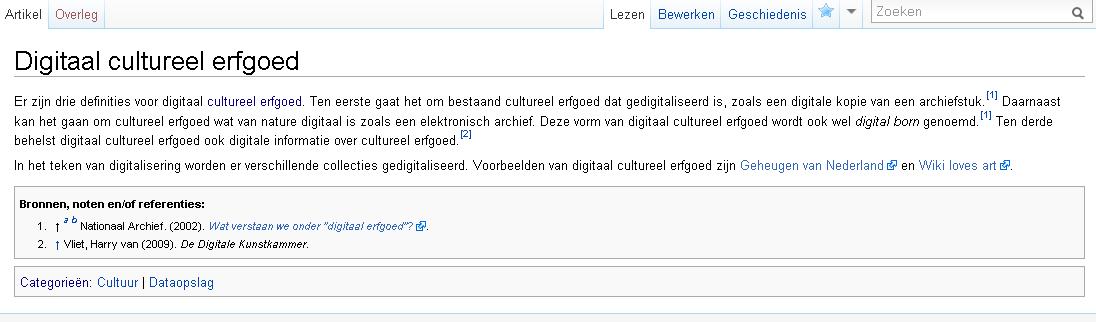
In comparison to my classmates the adjustments were gentle, most of their postings got brutally corrected or deleted. Which makes me wonder, why did I not get kicked off Wikipedia? I did not aspect to got approved by the moderator, this comes to me as a welcome surprise. It makes me wonder what would have happened if my post would have been deleted.
Still being in my information-manager-modus I look for some answers on the net. Doing so something tells me that there should be a Wikipedia page about this subject. And indeed, as expected from a Web 2.0. mechanism, different creative spurs have been documented. Such there is the Wikipedian song list, a table of songs about Wikipedia. The one I like expresses the feeling that I can imagine when getting kicked off your entry. I find the lyrics to be quite funny as well.
These generated user contents give a great look towards the actual Wikipedia community of knowledge sharing users. There are multiple pagers of warnings on how to prevent other negative outcomes of being active on Wikipedia like Wikistress [especially see nr.82 and nr. 133]. And to make sure a Wikipedian does not become a Wikidrop-out or a Wikiwacko these entries are the way to go.
In evaluating my Wiki entry I can conclude that the I applied to the one big criteria issue that Wikipedia is about; relevance. As seen on The Next Web, relevance is the thing to gain in Web 2.o. land. The subject I choose looks to be relevant for there was no information about digitized cultural heritage on the Dutch ‘Digital’ Wikipedia page, as there was no referring to cultural heritage here. Visa Versa there is no information on digitizing on the Dutch ‘Cultural Heritage’ Wikipedia page. By bringing those pages together in my entry by linking, I have shown the relation on these subjects and made a positive contribution to information network Wikipedia is.
Even the modifications that were made to my entry seem small, they do display the effort that is made in trying to making the entry more objective in order to make Wikipedia an objective encyclopedia. Having a critical point of view though, I wonder why a Web 2.0. initiative being modern and revolutionary in its class like Wikipedia would try to be an old, cold, medium such as a encyclopedia. Can Wikipedia not turn into something new, something defined as a term to be a Wikipedia and not a reshape of the old traditional definition? I am not the only one who has some kind of critique. Alan Shapiro explains that knowledge is based in society and as such Wikipedia not only represents knowledge, but also stupidity. And what most people believe in society is based on accepted clichés. He suggests that we must separate the real knowledge from the clichés and the stupidities. And he tells us that Wikipedia is about the democratization of knowledge and the promise of popular education. Therefore we need to find balance between the consensus culture such as Wikipedia and respect for the work of the scholar who has dedicated a lot of research on particular issues. According to Shapiro a model for balancing these two contributory streams needs to be developed.
The last thing has not been said on this Wikipedia critical point of view let alone for the next meeting will be in March 2011. In the mean time, I will go and explore my new online identity as Wikimedian.

